

From Firepower to Thought Power: The Future Operating Environments in an Age of Cognitive Competition
How advances in AI, autonomy, synthetic environments, neurotechnology, and data-driven influence are reshaping competition, military innovation, and the future operating environments
Friday 25 September 2026 | 10:30 - 11:30 | Interactive Webinar
In partnership with
The character of warfare is increasingly shaped not only by the ability to destroy, manoeuvre, or sustain forces, but by the ability to influence perception, accelerate decision-making, shape understanding, and create strategic effects in the cognitive space. As emerging technologies mature, the centre of gravity of conflict may (or may not) shift from platforms and networks towards the contest for attention, trust, judgement, and decision advantage.
This webinar will explore the extent to which advances in artificial intelligence, autonomous systems, simulation technologies, digital twins, synthetic media, neurotechnology, and pervasive sensing are changing the relationship between humans and machines in war. The discussion will also focus on how they may (or not) converge to create new forms of military power.
Looking beyond the operating environments, the webinar will also examine the implications for the defence innovation ecosystem. It will explore how new technologies may (or may not) influence the way capabilities are conceived, tested, developed, and delivered, and whether relationships between defence, industry, academia, and technology innovators could evolve in response to the dynamically evolving future operating environments.
This webinar is the second in a two-part series exploring the Future Operating Environments and serves as a precursor to the Future of War Conference on 25 November 2026.
This webinar will take place under the Chatham House Rule. Following a series of short provocations from the panel, the discussion will be opened to participants for questions, challenge, and debate.
Hear from:
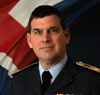 Air Vice-Marshal Mark Ridgway
Assistant Chief of the Defence Staff (Futures & Force Design), Military Strategic Headquarters
Air Vice-Marshal Mark Ridgway grew up in North London and joined the Royal Air Force in 1999, commissioning as an Intelligence Officer.
His staff tours to date have included in the Permanent Joint Headquarters, in the Air Warfare Centre, in 11 Group at Air Command, in the United States Central Command and in various professional roles across the RAF, Joint, Defence and international organisations. He has also had the privilege of commanding in single Service, Joint, pan- Defence, and multi-national entities. Mark has further deployed multiple times to Afghanistan, Iraq, and the wider Middle East.
Following a tour as Commander of the National Centre for Geospatial Intelligence, he became Director Defence Futures on promotion to Air Vice-Marshal in October 2024. Mark is a graduate of the UK Advanced and Higher Command and Staff Courses and an alumnus of the Windsor Leadership Trust.
Academically, Mark holds a Bachelor’s degree in Politics from the University of Nottingham and three Master’s degrees in: Terrorism Studies from the University of St Andrews; Defence Studies from Kings College, London; and Leadership and Management from the University of Portsmouth. The latter was conducted under a Chief of the Air Staff's Fellowship and focused on leadership of military and civil servant analysts. He subsequently completed a Doctorate in Business Administration under a further CAS Fellowship, studying empowerment and mission command in the Information Age military. Mark is a strong advocate of lifelong learning, diverse perspectives and empowered innovation.
In his spare time he enjoys running, reading and piano playing.
 Dr Victoria Smy
Lecturer in Defence Studies, King's College London
Dr. Vicki Smy is a Chartered Psychologist and Lecturer in Defence Studies at King’s College London, specialising in human cognitive capability and human-technology integration in defence contexts.
She has generated novel methodologies for training and preparation for future operating environments, including horizon-scanning techniques and skill-retention frameworks informing MoD policy and doctrine. Her present research projects include Reservist complex cognition training, rapid teaming (Police), and assessing AI sovereignty issues in crisis simulation (multi-domain).
In her role in professional military education, she leverages her expertise to integrate digital literacies and advanced thinking skills into officer education programmes at the Defence Academy.
 Iain Mackay
Account Executive, UK and EMEA National Security and Defence, Anthropic
Iain leads Anthropic's work with national security and defence customers across the UK and Northern Europe, helping governments adopt frontier AI safely and at scale. He joined Anthropic after four years at Faculty, where he worked with leading AI labs and UK public sector organisations on safety research and applied deployments.
Before moving into industry, he spent twelve years in the UK civil service working on national security issues.
His work focuses on how frontier models are reshaping intelligence analysis, operations, decision-making and cybersecurity, and on the procurement, assurance and institutional changes governments need to make to keep pace.
 Anthony (Tony) Reeves
Global Lead AI in Public Sector, Deloitte LLP
Tony brings over three decades of experience from the front lines of defence and national security to his role as a Partner at Deloitte, where he is Global Lead for AI in Public Sector.
His unique perspective, shaped by his time as a British Army Officer, government advisor, and Microsoft leader informs his work on helping clients adopt disruptive technologies and ethical AI. He's a challenging voice in the conversation around the future of warfare, advocating for mindset shifts to achieve digital transformation.